Downtown Denver is a treasure trove of preserved buildings and faded signs from the past (ghost signs!) Here I collect whatever I learn about the history, as well as my own captured ghost signs in time, because there's no guarantee they'll stick around as Denver keeps developing and growing. Thinking this could also make for a sick GIS project, maybe an annotated map or a guided route around LoDo.
If you spot a ghostsign around downtown and want to help preserve it, take a picture and submit it here!
The History
Downtown Denver (Lower Downtown = "LoDo") is a treasure trove of bits from the past. Preserved and littered all throughout Denver are remnants of the boom the city experienced at the turn of the 20th century. Gold discovered at the confluence of the Platte River and Cherry Creek sparked a rush to the frontier in 1858, and a second boom (this time for silver) hit in the 1880s. As miners flocked to the Rockies, so did others like merchants, bankers, and bakers to support the miners. The Ute and Arapahoe who had camped along the Cherry Creek for centuries watched as Denver developed a booming populace.
Railroads started to converge here: a central stop from the midwest, Texas, and the Pacific served as a cortoid artery for supply lines and stop offs. Railroads like the Denver & Rio Grande, the Denver Pacific, and Kansas Pacific lines had anything and everything passing through the city. Exchanging raw ore and mining equipment, livestock, ice, dairy, paint, and dry goods. Businesses arose along Wazee, Wynkoop, and Larimer streets to serve this bustling commerce but on the 19th of April 1863, a fire broke out in the city destroying nearly every wooden building in Denver. The city mandated a "Brick Ordinance" (which interestingly was kept in place until 1960, leading to the large number of brick warehouses turned into residential-buildings downtown). These drab brick walls would serve as a canvas to Denver's walldogs.
Though the name "walldogs" has a bit of a negative air about it, being a walldog was a title of pride. These were people who were artists, chemists, entrepreneurs, typographers, and acrobats. A historic relative of graffiti artists and muralists today, walldogs would scale walls with their crews to paint large eye-catching visuals. Oftentimes with a setup swinging from a single rope tied to the building, you can imagine they resembled rappellers at the climbing gym (but with a bucket of paint instead of a bag of chalk, and a brush in the other hand). The higher the site of the painting, the more risky to the painter (and higher the hazard pay).
Part artist, part gymnast, and part chemist: even wall painting and street art has the magic of alchemy. Back in the day, painters didn't have the luxury of aerosol cans, or pre-mixed paint. Mixing the paint by hand, these artist-chemists would balance a combination of pigment powders, additives like linseed oil, and white (extremely high levels of) lead based paint. You can imagine the amount of lead used if the murals are still visible 120 years later! Walldogs would end up with "painter's colic", affecting their cognitive abilities and leaving some deaf.
Ghostsigns I've Caught in the Wild
The Old GE Building
1441 18th Street

Back in the day, Denver's industry was dominated by smelting and refining, and as industry grew so did the electrical infrastructure required. Built in 1906, General Electric used this building to "warehouse and distribute electrical supplies" throughout Colorado.
Lipton Tea Ad
2060 Larimer Street
On the side of a former apartment building on Larimer street is an ad for Lipton's Tea that claims that it "builds muscular men." First painted by the James A. Curran Bill Posting and Distributing Company, this sign was restored by Mark Oatis in 1997.
20th Street Gymnasium
1011 20th Street
First opened in 1908 as the Denver Municipal Bath House and Gymnasium, this building now houses the 20th Street Recreation Center. Still serving the Downtown Denver community over a century later, the building now hosts a wide array of facilities including a lap pool, boxing gym, pickleball court, gymnasium, weight and cardio rooms, a pottery studio, and an art room.
The Old Littleton Creamery and Beatrice Foods Cold Storage Warehouse
1801 Wynkoop Street
Prior to refrigeration, ice houses were required to keep perishable items unperished. The modern Icehouse building served as the cold storage facility for the Old Littleton Creamery (later bought out by the Nebraska-based Beatrice Foods).
One of many buildings preserved by conservationist Dana Crawford, after the cold storage facility was abandoned, the bulding was renovated in 1984 and now houses the Ice House Lofts, the Icehouse Tavern, Rodizio Grill, and the Bent Lens optometrist.
Pride of the Rockies Flour Mill/Longmont Farmers Mill
2000 Little Raven Street
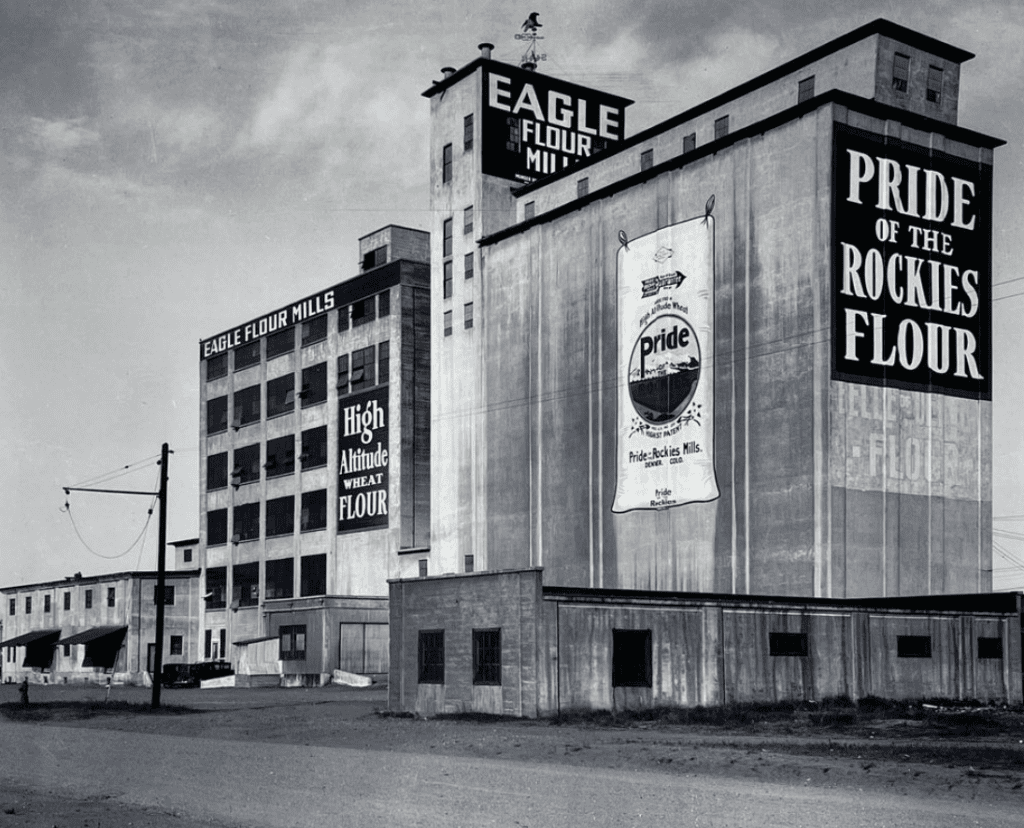
Originally home to the Pride of the Rockies flour mill, the building was converted into a luxury apartment complex right next to Confluence park, right where it all started.
Though it's been shifted around and cut off during the demolition and reconstruction, some of the original signage (the Pr from "Pride" and the Ro from "Rockies) are still visible on the facade.
Further Sources and Reading
- Hidden History of Denver – Elizabeth Victoria Wallace (book)
- Denver Public Library Librarians
- The Destruction and Rebirth of 30 Blocks of Downtown Denver – Denverite
- Historic Buildings Map – Denver Public Library
- LoDo Then & Now - LoDo District
- Six Historic Denver Buildings Dana Crawford Helped to Save – The Crawford Hotel
- Denver Ghostsigns: An Embarrassment of Riches, Part One – Ghost Signs and Roadsides
- Denver Ghostsigns, Part Two – Ghost Signs and Roadsides
- Public Art – Denver Infill
- Historic Downtown Denver Sign Replaced for Cleaner Image – Denver Gazette
- The Ghost Signs of Denver – Denverite Express
- Walldogs, Ghost Signs and Slappy Hooper (PDF)
- Walldogs and the Disappearing Art of Painting Signs on Buildings – Atlas Obscura
- A Short Oral History from a Real-Life Walldog – Living Gold Press