One of the first pedals people encounter on audio circuit forums or in tutorial videos is the Bazz Fuss. It's a low-component count easy to solder circuit that produces a wonderfully fuzzy distortion with an ass-kicking tone.
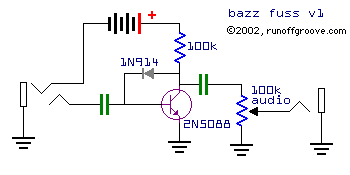
Most of these components, I still had from the chemical engineering controls lab class I took in undergrad. I luckily had a 2N5088 transistor (it's quite common) but I had to approximate the capacitor values by rearranging caps I had on hand.
The circuit started on a breadboard, and the sound was noisy as all hell. (I'd later learn on a forum that breadboards aren't ideal for testing an effect cleanly when making pedals). Not just the messy contacts between components but the circuit was actually picking up and amplifying radio signals! I play my bass guitar through an audio interface in Logic Pro and you could vaguely make out the words that a broadcaster was saying.

My second go was a modified P2P (point to point) soldered version of the same pedal. No PCB or perf board, no board at all; I just directly soldered component leads to each other and made long terminals using solid core wire. It worked (sounded a bit like a fart effect with my bass) but I ended up snapping the small and delicate circuit when I yanked the cable it was attached to off a table.

At this point, I've becomed enamoured by the circuit. I was playing around with resistance and capacitor values on a noisy breadboard, and was making a lot of mistakes. I saw that MAS Effects created a pedal kit variation on the bazz fuss called the Quick Fuzz.

The added structure of a PCB, provided select components, jacks and enclosure made the process of makign a pedal so much smoother. It's like putting together legos or assembling a computer, there's a right place for every part to go, and through the structure provided there's less opportunities for error. Their guides on soldering also serve as a fantastic reference when getting started.
I love this circuit, you can have such a wide range of sounds and tones playing with resistors and capacitors, and at its core is the simplest configuration of a diode and a transistor.
I'm writing a longer post on my learnings on the bazz fuss circuit, but if you want to play around with it yourself, I've made a file for simulating the MAS Effects QuickFuzz pedal using the Falstad Circuit Simulator. Click File → Import From Text and copy and paste the below in:
$ 1 0.000005 11.086722712598126 58 5 50 5e-11
r 192 240 192 304 0 1000000
r 304 112 304 192 0 510000
d 256 192 256 240 2 1N4148
R 304 112 304 80 0 0 40 9 0 0 0.5
O 432 240 496 240 0 0
R 192 240 160 240 0 3 40 10 0 0 0.5
c 192 240 256 240 4 2.2e-7 6.882889369789616 0.001 0
w 256 192 304 192 0
c 304 192 368 192 4 1.0000000000000001e-7 -4.682454981351551 0.001 0
t 256 240 304 240 0 1 -0.48875734512986035 -10.274889315414036 300 default
w 304 192 304 224 0
g 192 304 192 336 0 0
174 304 256 304 336 1 10000 0.5990000000000001 GAIN (10K)
g 304 352 304 384 0 0
w 304 352 352 352 0
w 352 352 352 304 0
w 352 304 320 304 0
w 368 192 416 192 0
174 416 192 416 272 1 100000 0.3119 VOL (100K)
g 416 288 416 320 0 0
x 368 245 404 248 4 18 VOL
x 247 312 291 315 4 18 GAIN
o 5 64 0 4099 10 0.00078125 0 2 5 3
o 4 64 0 4098 10 0.00009765625 1 1
Try playing around with the generation waveform, the values of the vol and gain potentiometers (maybe swap the current limiting resistor under the battery with a 510k potentiometer, see what happens)! It's a lot of fun to muck about with.
It truly amazes me the range of sounds, and the strength of effect that this tiny circuit with a handful of resistors and capacitors, a single transistor, and single diode can elicit. I feel like the canonical next step is to explore the Fuzz Face circuit.
I'll be writing more notes on pedals, and collecting the resources that I'm using to teach myself on my /learning page. There's some fantastically dope and wildly intelligent people building and teaching in the space. Check them out!!!